5Mo·

Saturday review of some of my swing trades📑

$UBER (-0,08 %)
$KTN (-1,19 %)
$ZAL (+5,58 %)
$LNZ (+0 %) a look at 3 current and one potential new swing trade👓


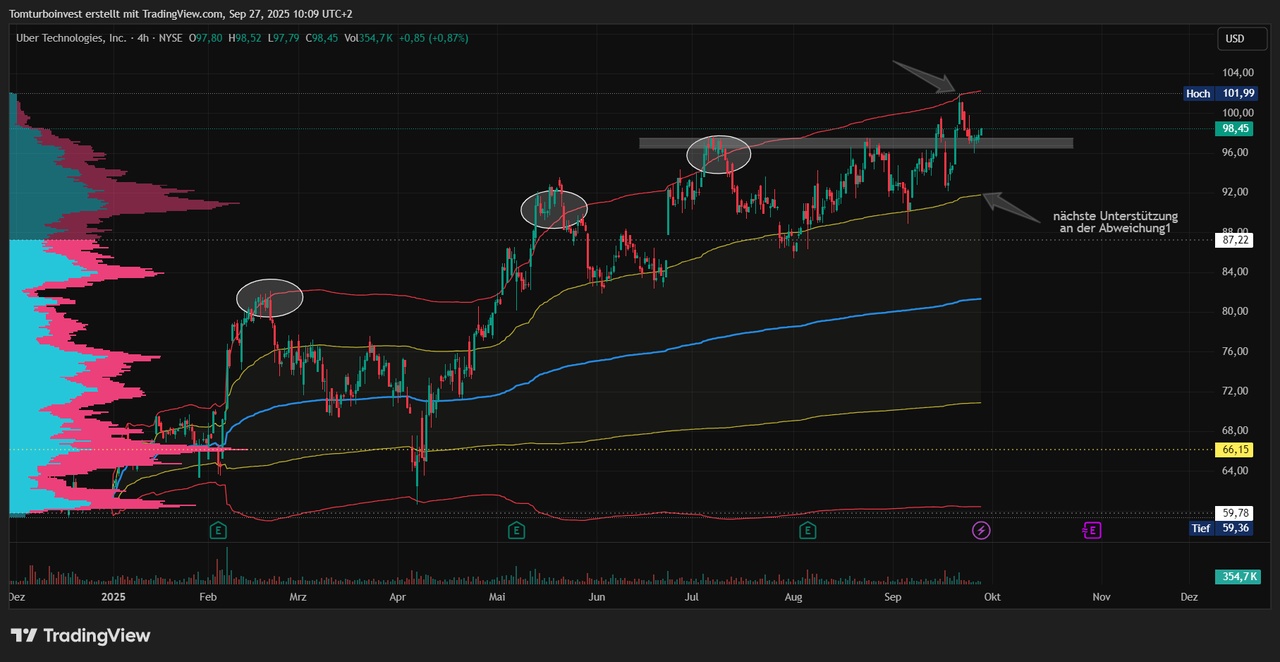
$UBER (-0,08 %) As posted a few days ago, this week the resistance at the deviation2 of the VWAP was once again too strong, BUT a former resistance showed up as support at the end of the week. That would be a good basis for another attempt in the next trading week. It remains exciting😁
attachment

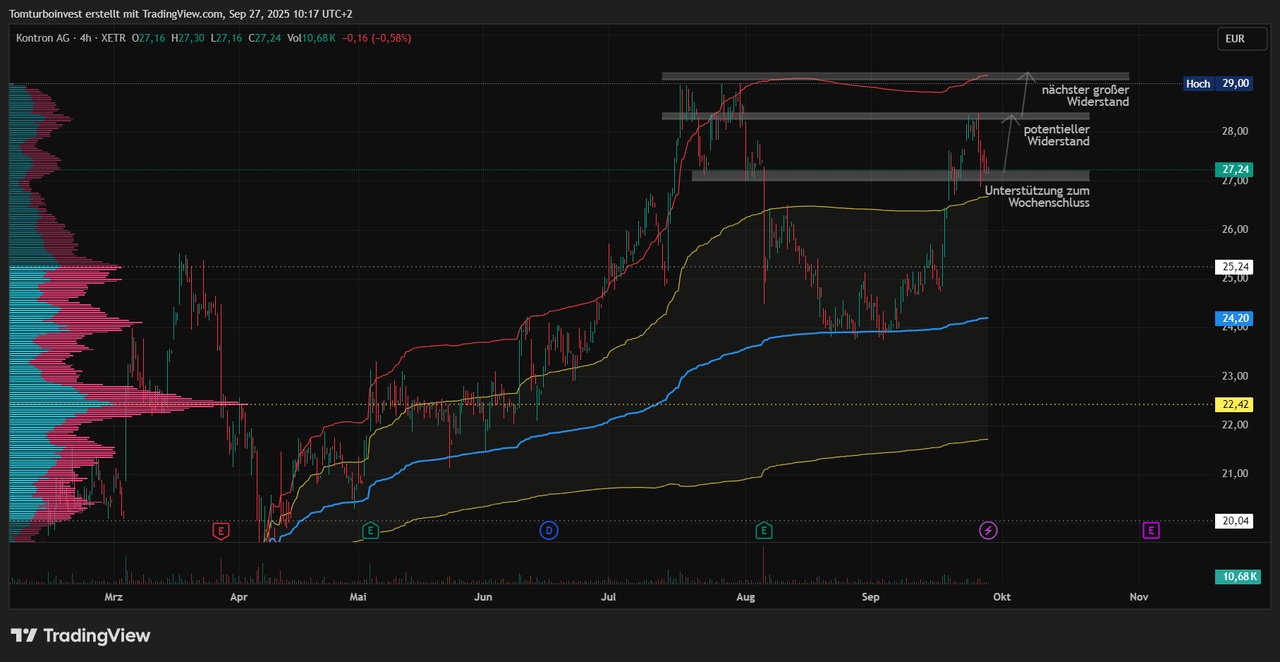
$KTN (-1,19 %) Similar to Uber, Kontron also failed at a technical resistance zone in the course of the trading week. However, a former resistance zone also proved to be support for Kontron at the end of the week. Here, too, a renewed rise could test the resistance upwards and run through to the divergence2 of the VWAP. This divergence2 has been proving to be resistance all year and could not be broken sustainably.
attachment

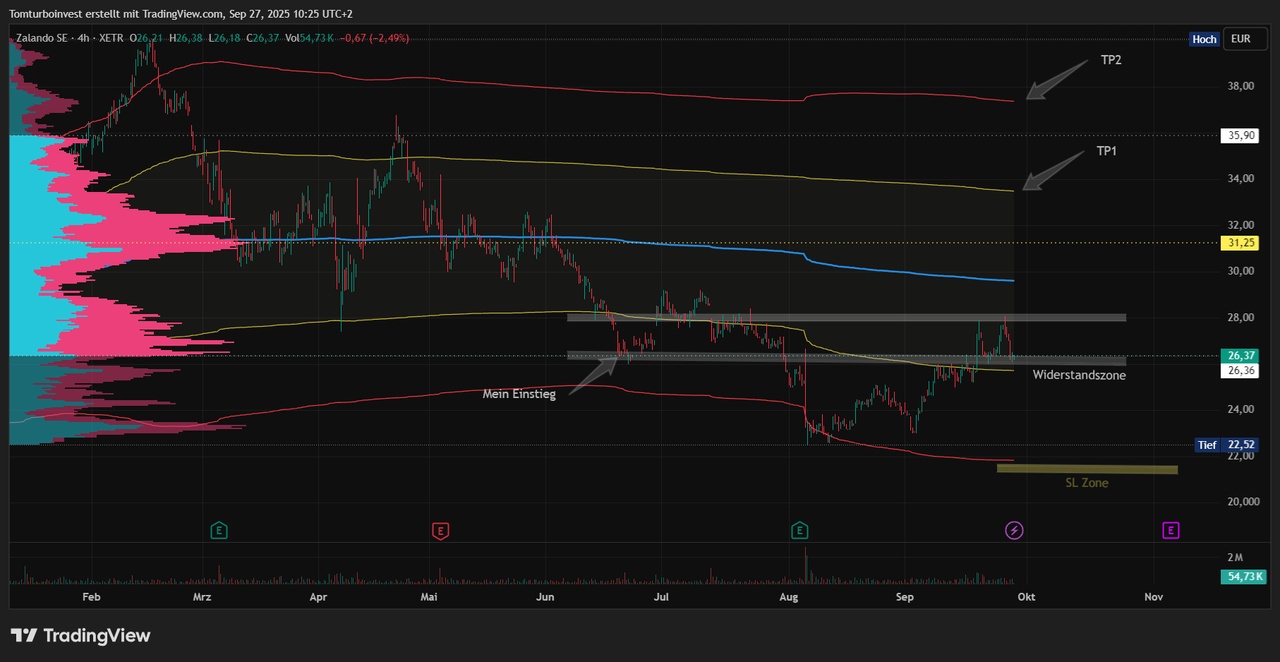
$ZAL (+5,58 %) is also struggling, but a whole "floor" below it😅. The first lower divergence of the VWAP has been a battle zone for Zalando since June. At least a support from June held at the end of the week. Take profit targets remain in place. I currently see the downside risk limited at the divergence2. I.e. my SL is only below this zone.
attachment

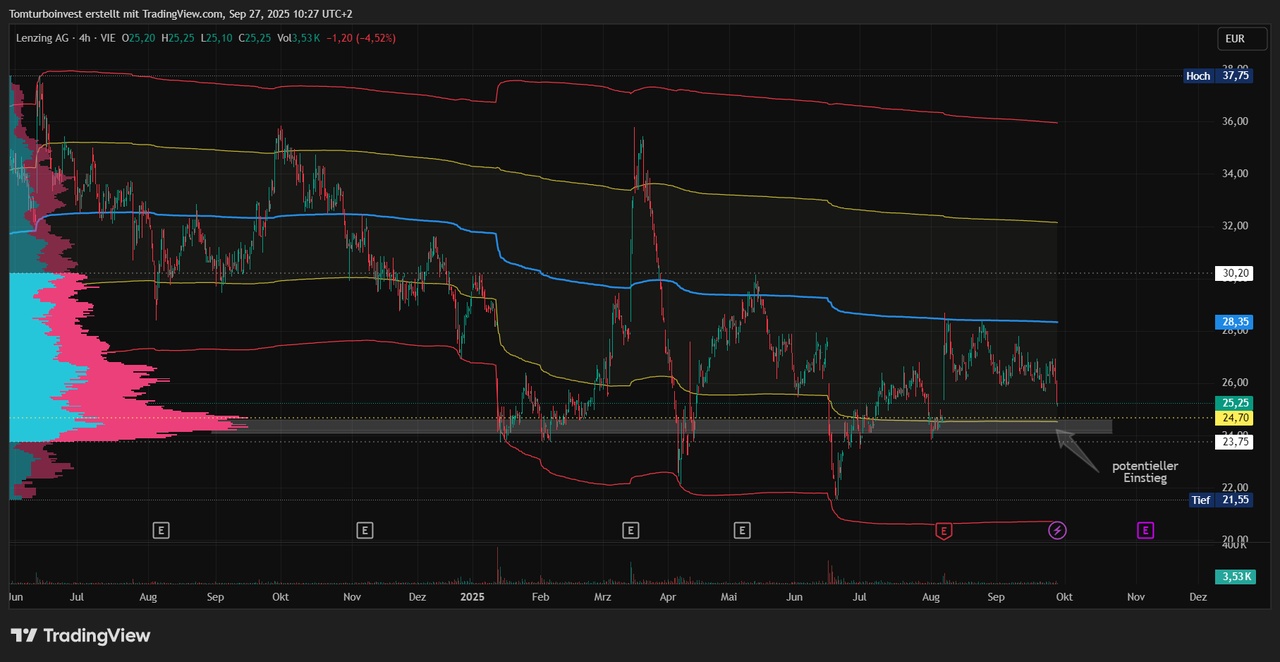
$LNZ (+0 %) With Lenzing I am again waiting for an entry. When deviation1 is reached, where there is also a HighVolumeNode, I am back in with a first position💰
attachment

#trading

17
20 Commentaires

image de profil
I would also be interested in the name of the indicator.
1
Utilisateur supprimé
5Mo
Le commentaire a été supprimé
image de profil
@Garondt This is the anchored VWAP, which I can "anchor" exactly where it is interesting for me. Normally to the last significant low before the trend change. You can see this quite well in the Kontron chart. The others are zoomed in almost too far😅
With the VWAP you can see exactly at which volume-weighted prices the market has positioned itself since the point in time where you are anchored. The VWAP is also very popular with institutional investors, as you can read time and again in SEC filings. They often use the monthly or quarterly VWAP, i.e. it is always read at the beginning of the period. Just like in day trading, where you use the VWAP of the session. You can then see how the market has positioned itself since the start of trading that day.
1
image de profil
@Savvy_investor_2000 In TradingView there are several variants of the VWAP - what they have in common is that they all take into account the volume-weighted average price of all trades. The VWAP of the free version can be set e.g. per session, per week, per quarter etc. up to 10 years.
I use the anchored VWAP, which is only included in the subscription model, BUT you can set it exactly where you want it for your trading strategy.
Utilisateur supprimé
5Mo
Le commentaire a été supprimé
image de profil
@Savvy_investor_2000 That's right!
Wait a minute, that's the joke! The prize only knows where it wants to go AFTER I've posted my interpretation. If I follow it blindly, it can't make up its mind.
I am the Heisenberg uncertainty principle of trading.
So we keep interpreting so that the price finds a direction😎😂
1
image de profil
Tom Turbo is one of my favorite childhood heroes and with this profile now also of adult age 😜
1
Utilisateur supprimé
5Mo
Le commentaire a été supprimé
image de profil
@Iwamoto the majority of my trades are swing trades at the medium time level, but when it suits me I also have day trades from time to time. I then trade according to the VWAP of the session.

The indicator is the anchored VWAP, which I can "anchor" as I wish, usually to the last significant low before the swing change. This is included with TradingView from the "Essential" package onwards. You can see how the market has positioned itself since then.
You can switch the bands on or off in the indicator settings.

PS: you can switch the bands on for every VWAP, not just the anchored one
image de profil
@Iwamoto PS: here is a quick answer to your question about short-term trades. If it's supposed to be very short-term - day trades - then you can see my TradingView screener settings in this post.
I look specifically 30-60 minutes after the start of trading to see if there is a gap up, and then I make my decisions based on the VWAP of the session. I can't tell you today what might be interesting in the short term on Monday. But take a look at the post, maybe you can derive something for yourself https://getqu.in/pcSokD/
Utilisateur supprimé
5Mo
Le commentaire a été supprimé
image de profil
@Iwamoto you just have the Auto anchored VWAP with reset on a monthly basis, and not the anchored VWAP, which you can anchor where you want. The anchored VWAP can be selected in the toolbox, not in the search bar for indicators.
With the aaVWAP you can also replicate the aVWAP to a certain extent if you set it to lowest low instead of month and adjust the period accordingly. But it recalculates itself every time unit (1h, 4h, 1D)
You will not be happy with the free VWAP in the long run.

PS: aVWAP can be found under Forecast and measurement tools
Utilisateur supprimé
5Mo
Le commentaire a été supprimé
image de profil
@Iwamoto that's him 😁

Now you just need to get a feel for the best place to put it. For swing trades, I recommend the swing change to the last low before going up again. If you activate the "magnet", you can easily hit the low of the candle
Utilisateur supprimé
5Mo
Le commentaire a été supprimé
image de profil
@Iwamoto oh - meli looks technically interesting. Thanks for the link, I no longer need to check the chart myself - I'm familiar with the VWAP 🤗
Utilisateur supprimé
5Mo
Le commentaire a été supprimé
image de profil
@Iwamoto I have just increased my Uber Core position again - is in the short-term upward channel at the lower edge https://www.tradingview.com/x/2ubx2Bmq/
Voir toutes les 2 autres réponses
Participez à la conversation