
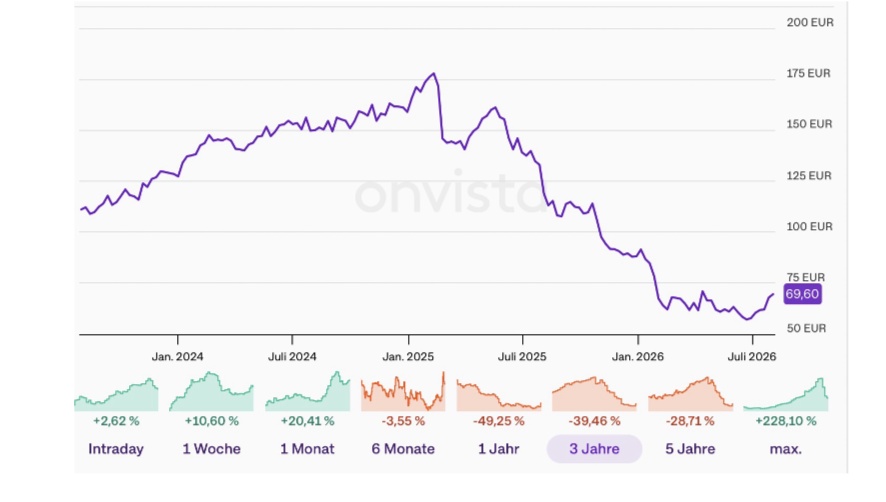
Today we want to take a closer look at a software stock: Wolters Kluwer $WKL (+1,39 %) . This stock has caught my attention recently, as it may actually have bottomed out.
Step 0: Real-Time Data & Context
Current Price: ~69.98 EUR
Currency: EUR (Euronext Amsterdam)
Market Capitalization: ~16.2 – 18.8 billion EUR
52-Week Range: 54.64 EUR – 138.75 EUR
P/E Ratio (Normalized): ~12.0x – 12.4x
Cyclicality: Non-cyclical / Defensive (software, specialized information, and workflow tools in law, tax, finance, and healthcare).
Point 1: Business Model & Disruption Check
Wolters Kluwer has completed its transformation from a traditional specialist publisher to a global B2B software and information service provider.
AI Disruption Check: Positive to Neutral-Positive (8.5/10). The company deeply integrates generative AI into its expert solutions (e.g., legal and tax databases) to provide professionals with automated analyses. Its own proprietary subject-matter data ensures data quality that public AI models cannot easily replicate.
Core Model: Over 80% of revenue is recurring (subscriptions and SaaS licenses). Switching costs for lawyers, tax advisors, and doctors are extremely high, as their workflows are deeply embedded in Wolters Kluwer software.
Point 2: Competitive Moat & Market Position (9.0/10 points)
Competitive Moat: Excellent. High switching costs (high user lock-in) and regulatory/legal specialty databases built up over decades.
Market Position: Leading global provider in the core segments of Tax & Accounting, Health, and Financial & Corporate Compliance, alongside competitors such as RELX and Thomson Reuters.
Point 3: Financials & Deep Risk (8.5/10 points)
Growth (8.0/10): Organic revenue growth is consistently in the range of 5–7% per year, driven by digital expert solutions.
Margins (9.0/10): Operating margins (EBITA) are stable at over 26–27%, with very high cash conversion (close to 95–100%).
Debt / Balance Sheet (8.5/10): Solid investment-grade balance sheet with moderate net debt. The company regularly uses its free cash flow for share buybacks and dividends.
VETO-CHECK: No insolvency or liquidity risk.
Point 4: Valuation & Peer Group (8.5/10 points)
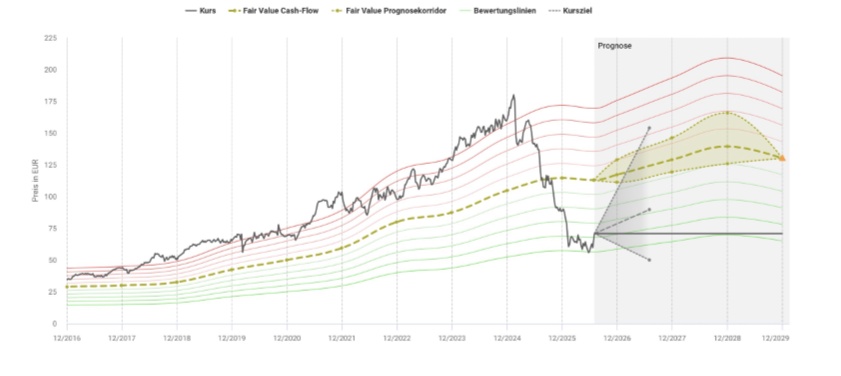
P/E ratio: ~12.0x – 12.4x | Dividend yield: ~3.6%.
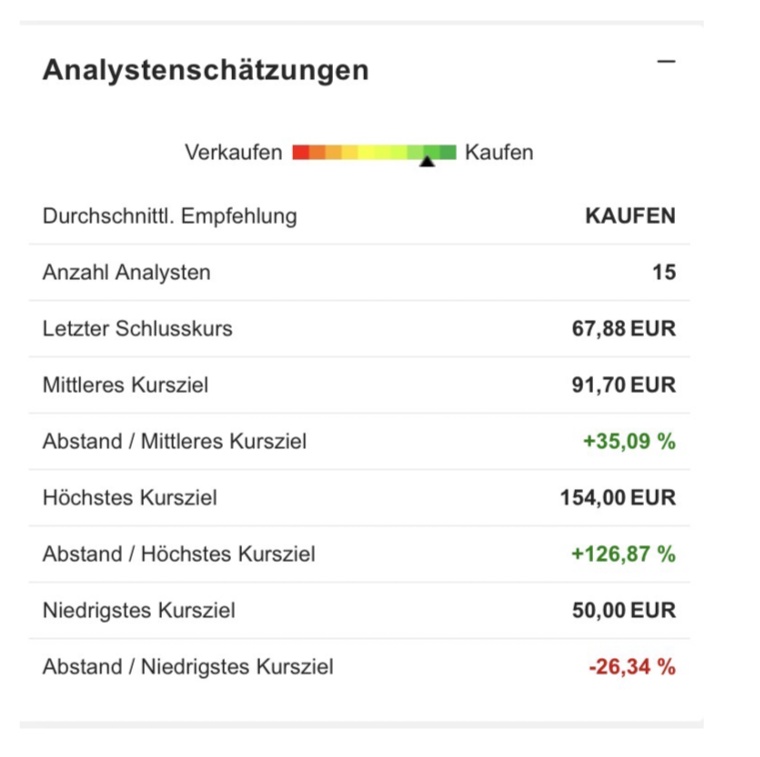
Comparison: Compared to peers such as RELX (~20x–21x) or Thomson Reuters (~25x–27x), Wolters Kluwer is currently trading at a significant valuation discount following consolidations over the course of the year, which makes the risk-reward ratio attractive.
Point 5: Technical Analysis (7.5/10 points)
Trend: Following a prolonged consolidation phase away from the 52-week high, short-term indicators (RSI, breakout above the resistance zone at 69–70 EUR) point to a shift in momentum. The range around 55–60 EUR has established itself as solid support.
Nevertheless, AI remains a key risk. The idea is this: if a company operates more efficiently, it needs fewer licenses. Consequently, Wolters Kluwer’s revenue and profits would plummet. However, the following points counter this view:
1. The Shift in the Pricing Model: From Per-Seat to Value-Based
The market is already transitioning from pure per-seat licensing to new billing models:
Hybrid & AI Surcharges: Wolters Kluwer charges significant price surcharges per user or module for AI-enhanced features (e.g., advanced AI research assistants).
Outcome & Usage Pricing: When a tool resolves a case in minutes rather than hours, billing is increasingly shifting toward the added value delivered (value of the generated document/analysis) rather than pure processing time. As a result, revenue per user (ARPU) increases significantly, more than offsetting the potential decline in the number of users.
2. The Jevons Paradox (Greater Efficiency = More Work)
In practice, AI-driven efficiency gains among tax advisors, auditors, and law firms rarely lead to waves of layoffs. Instead, the following happens:
Law firms use the freed-up capacity to take on more clients and handle more complex areas of consulting.
The volume of work is growing steadily in line with regulatory requirements (e.g., new ESG mandates, global tax reforms). More clients mean more intensive use of the platforms.
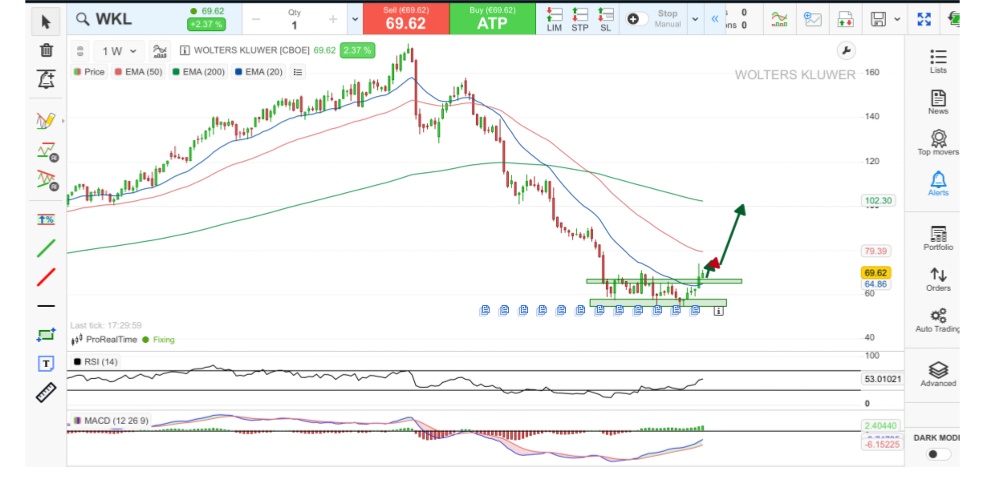
If we take a closer look at the chart, we can clearly see the massive price declines, which, in my opinion, are unfounded. The bottom has most likely already been reached, and the MACD has been signaling a buy on a weekly basis for some time now. Furthermore, according to the RSI, the market is not yet oversold, but the relative strength, at 53, is clearly on the bulls’ side.
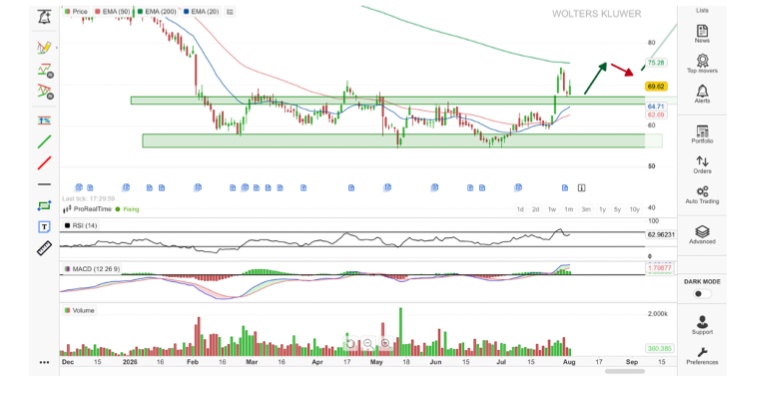
Switching to the daily chart, you can also see how the price is cleanly bouncing off the 200 EMA, and the 20 and 50 EMAs are actually crossing positively. After briefly entering overbought territory, we’ve now pulled back nicely and are bouncing off the next support line again. I see a major support zone here. A possible price path is plotted in the chart, provided this level holds.
What are your thoughts on the software sector—are you invested? What did you think of the analysis, and will you be buying into Wolters Kluwer?
Feel free to share your opinions!
etc...


