

Hello, everyone,
Since my boyfriend @Raketentoni Mr. Prompt has been really hyper today. And @Aktienhauptmeister Jack has already done a great job today, so here’s a second company spotlight.
Here we’ll be discussing risk and opportunities.
Ever since the memory crisis and the strong performance of the relevant companies, everyone’s been talking about DRAM, but very few are mentioning MRAM.
To help you better assess the company, I’ve explained the difference below. That’s why this overview has turned out to be a bit longer.
(If you’re already familiar with the topic, feel free to scroll down or leave a comment.) @ScaleLimits
But I’m also very excited to hear your comments, my friends.
Everspin Technologies: The Pioneer of Magnetic Storage
As the global market leader in MRAM storage, Everspin occupies a critical niche that combines the speed of RAM with the non-volatile data storage of flash modules. Thanks to exclusive large-scale contracts from the U.S. Department of Defense, the company has become an indispensable pillar of national security and domestic chip production. Its expansion into edge computing and industrial AI applications is paving the way for Everspin to make the leap from a specialized niche to the global mass market.
Everspin Technologies, Inc. is a developer and manufacturer of magnetoresistive random-access memory (MRAM) solutions. Its portfolio of MRAM technologies includes toggle MRAM, tunnel magnetoresistance (TMR) sensors, and spin-transfer-torque MRAM (STT-MRAM). Toggle-MRAM products are designed for applications in the industrial, medical, automotive/transportation, and data center sectors. The company offers these products with industry-standard interfaces, including parallel, Serial Peripheral Interface (SPI), and Quad SPI (QSPI) interfaces. STT-MRAM technology can be adapted to provide products for DRAM, SRAM, and NOR flash applications. TMR sensors offer high magnetic sensitivity in a single component that performs 3D magnetic field measurements in a monolithic solution. The company sells its products directly and through its distribution channels to original equipment manufacturers (OEMs) and original design manufacturers (ODMs).
Number of employees: 85
⚡ DRAM vs. MRAM – The Real Difference
🧠 DRAM (Dynamic RAM)
- Volatile memory → Loses data as soon as power is cut off
- Must be constantly refreshed (thousands of times per second)
- Extremely fast (nanoseconds)
- Very cost-effective
- Used in PCs, servers, and smartphones as main memory
- Scalable up to the gigabit/terabyte range
- Disadvantage: High energy consumption, not radiation-resistant, not robust
In short: DRAM is the world’s “working memory”—fast, cheap, but not persistent.
🔒 MRAM (Magnetoresistive RAM)
- Non-volatile → retains data without power
- No refresh required → Extremely energy-efficient
- Very robust (temperature, radiation, vibration)
- Faster than flash, in some cases comparable to DRAM
- Can be placed close to the CPU → reduces latency
- Ideal for industry, aerospace, defense, automotive, and edge computing
- Still more expensive and lower in density than DRAM/NAND
In short: MRAM is an ultra-fast, robust, power-independent memory—perfect for critical systems.
🚀 Why MRAM has great potential
1️⃣ Non-volatile + fast = unique
MRAM combines the best of both worlds:
- The speed of DRAM
- Persistence of flash
This combination is otherwise elsewhere.
2️⃣ Edge Computing & Industry 4.0
MRAM is ideal for:
- Machine controls
- Robots
- Sensors
- Automotive control units
- Energy and network technology
→ Sectors that are growing exponentially.
3️⃣ Aerospace & Defense
MRAM is:
- radiation-hardened
- extremely reliable
- temperature-stable
→ That is why MRAM is used in satellites, rockets, aircraft, and military systems.
Everspin is the only U.S. supplier.
4️⃣ UNISYST (Everspin) could replace NOR flash
NOR flash is a $3–4 billion market. UNISYST is targeting exactly that—with advantages:
- faster
- more robust
- closer to the CPU
- more energy-efficient
If UNISYST works, MRAM will more suitable for mass production and could replace NOR flash.
5️⃣ MRAM is perfect for “instant-on” systems
Example:
- Cars
- Industrial machinery
- Medical devices
- Network technology
→ Systems that need to start up immediately, without a boot time.
6️⃣ Energy efficiency is becoming a megatrend
MRAM requires no refresh → saves a massive amount of energy. In data centers, that’s a billion-dollar argument.
🎯 Investor takeaway
DRAM
- Mass market
- Cheap
- Fast
- Volatile
- Dominant in Consumer & Server
MRAM
- Niche Market (for now)
- Non-volatile
- Fast
- Rugged
- Ideal for industrial, aerospace, and defense applications
- Potential to replace NOR flash
- Potential for new memory architectures (CPU-proximal memory)
MRAM will not replace DRAM—but it will capture markets that DRAM cannot serve. And that is precisely where Everspin’s growth potential lies.
Everspin auf Oppenheimer-Konferenz: Wachstumspläne gewinnen an Fahrt
🔍 Article summary: Everspin at the Oppenheimer Conference
🚀 Growth is picking up noticeably
Everspin Technologies is signaling a clear transition from years of stagnant revenue to accelerated growth, driven by:
- rising product demand
- new foundry partnerships (Microchip, GlobalFoundries, and TSMC in the future)
- a major government contract
- the development of the new high-density memory UNISYST
📈 Financial Highlights
- Q2 2026 Revenue: $18.7 million → Record quarter
- Q3 2026 Forecast: $19.5–20.5 million
- Product revenue grows +38% YoY
- Long-term revenue target: $100 million by 2029
- Gross margin stable at ~50–54%
- Cash: $43.9 million, no debt
- For years, positive operating cash flow
🏭 Operational expansion
Everspin is massively expanding its manufacturing capacity:
- Current fab: NXP Chandler (Arizona)
- New capacity: Microchip Gresham (Oregon)
- STT-MRAM Development: GlobalFoundries
- Production scheduled to begin in late 2026/2027
- Investments in the Microchip project: ~$14.5 million
Goal: Supply chain resilience across multiple fabs and technologies (Toggle-MRAM, STT-MRAM, UNISYST).
🧠 Product Portfolio
PERSYST
Toggle & STT-MRAM → current core business.
UNISYST (next-gen memory)
- Targets the $3–4 billion NOR flash market
- Launch: 256 Mbit, later up to 2 Gbit+
- Advantages: non-volatile, extremely robust, radiation-hardened, close to the CPU, fast
- Target markets: aerospace, data centers
- Tape-out by the end of 2026 → Revenue starting in 2028/2029
🛡️ Legal dispute with Avalanche Technology
- Patent lawsuit since January 2026
- Costs: ~$4 million per quarter through mid-2027
- Everspin believes it is in a strong position to defend itself
- ITC ruling: Summer 2027
A short-term burden, but not a strategic setback, according to management.
🏛️ Major government contract
- $40 million subcontract (April 2026)
- Revenue to be recognized over 2.5 years
- Largest share in 2027
- Boosts margins
- Strengthens role as the only U.S. provider of MRAM for critical applications
🌐 Market position
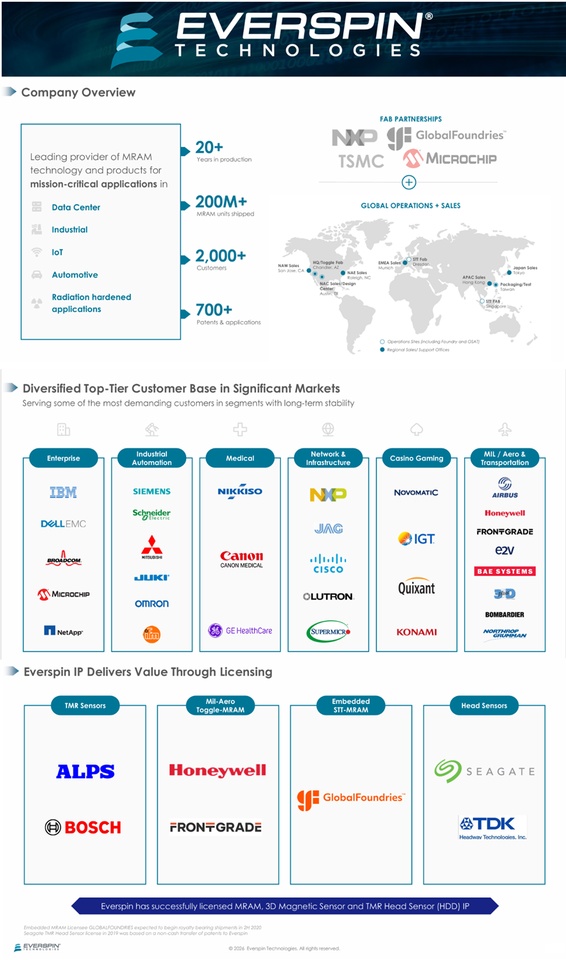
- 200 million units shipped
- 2,000 customers (including IBM, Siemens, Schneider Electric, and Mitsubishi)
- 700 patents
- The only U.S. manufacturer of MRAM for government missions
- Target market by 2029: $4.3 billion TAM
🔮 Outlook
- Revenue target for 2029: $100 million+
- Key drivers: PERSYST + licenses
- UNISYST is expected to exceed the size of the existing business starting in 2030/2031
- Focus on Enterprise, Aerospace, Defense, and Data Centers
🚀 Opportunities from Everspin Technologies (MRAM)
1. Rapidly accelerating growth
- Product revenue is growing +38% YoY
- Q2 2026 was a record quarter
- Q3 guidance rising again
- After years of stagnation, a clear trend reversal is now evident
Why it matters: Turnaround stories backed by real numbers are rare—and here it’s happening.
2. Strategic foundry expansion (Microchip, GF, TSMC)
- Production to be spread across multiple fabs
- Reduces dependence on NXP
- Increases capacity and supply reliability
- STT-MRAM and UNISYST become scalable through new partners
Why it matters: Multi-foundry = scalability + resilience → a prerequisite for $100 million in revenue.
3. UNISYST: Potential game-changer
- Targets the $3–4 billion NOR flash market
- Advantages: fast, robust, radiation-hardened, close to the CPU
- First version: 256 Mbit → later up to 2 Gbit+
- Tape-out in late 2026 → Revenue starting in 2028/2029
Why it matters: If UNISYST works, it will be bigger than the current business.
4. Government contract (40 million USD)
- Duration: 2.5 years
- Largest share in 2027
- High-margin
- Strengthens position as the only U.S. MRAM provider for critical missions
Why it matters: Predictable revenue + political relevance.
5. Very strong balance sheet
- $43.9 million in cash
- No debt
- For years positive operating cash flow
Why this matters: Growth can be financed internally
6. Market Position & IP
- 200 million units shipped
- 700 patents
- 2,000 customers
- The only U.S. manufacturer of MRAM for the defense and aerospace sectors
Why it matters: Technological moat + high barriers to entry.
⚠️ Risks associated with Everspin Technologies
1. Patent lawsuit with Avalanche Technology
- Costs: ~$4 million per quarter through mid-2027
- ITC ruling: Summer 2027
- Worst-case scenario: Import ban on certain products
Why this is critical: High costs + potential operational damage.
2. UNISYST is a “moonshot”
- Tape-out not until late 2026
- Commercialization in 2028/2029 at the earliest
- Technical risk: performance, yield, costs
- Market acceptance unclear
Why it’s critical: The biggest growth driver is not yet on the market.
3. Dependence on a few large foundries
- NXP, Microchip, GF, and later TSMC
- Delays or technical issues could push back the roadmap
Why this is critical: Fab risks are always systemic.
4. High customer diversity, but few “mega-customers”
- Many small customers → stable
- But: A few large customers drive volumes
- The loss of a major customer would be significant
5. MRAM is a niche market
- Not yet a mass market like DRAM/NAND
- Growth depends heavily on the enterprise, aerospace, and defense sectors
- Competitors (Avalanche, Samsung, NXP) are also developing MRAM
6. Long-term goals are ambitious
- Revenue target for 2029: $100 million
- This will require:
- UNISYST success
- STT-MRAM scaling
- Seamless multi-foundry production
- No patent roadblocks
Why this is critical: Many dependencies, little fault tolerance.
🎯 Quick takeaway for you as an investor
Everspin is a rare combination of:
- debt-free
- profitable
- a technology leader
- with a clear growth story
- and a potential “moonshot” (UNISYST)
But: The patent lawsuit and UNISYST’s technical uncertainty are the two major risks that could impact the stock price at any time.
Everspin Technologies Inc: Earnings Call Q2/2026 - Roundup
- Everspin reported record second-quarter revenue of $18.7 million, a 42% increase year-over-year, with non-GAAP EPS of $0.11, which beat estimates by $0.12, compared to an expected loss of $0.01.
- The third-quarter guidance calls for revenue of $19.5 million to $20.5 million and non-GAAP EPS of $0.10 to $0.15, supported by a defense subcontract and demand for industrial automation.
- Product gross margins fell to the mid- to high-40s percent range due to packaging costs and cost inflation in the backend, although the overall gross margin was maintained at 53.9%.
- The company secured a $40 million defense subcontract with non-linear revenue recognition; it is also developing CXL-based MRAM for data centers with a three-year time horizon.
- The liquidity position strengthened to $43.9 million with zero debt; litigation costs of approximately $4 million are expected to continue to be incurred as the company pursues a dual-foundry strategy with Microchip.
Everspin übertrifft im zweiten Quartal 2026 die Prognosen und erzielt Rekordumsatz
- Investing.com
- Aug. 6, 2026
Everspin Aktie springt um 14 % nach KI-Partnerschaft mit MaxLinear
- Investing.com
- Aug. 4, 2026
Everspin liefert Speicherchip für Satellitenmission von Astro Digital
- Investing.com
- July 29, 2026
Everspin Announces Expansion of Industrial STT-MRAM Devices
"Product features additional 4Mb capacity, a smaller package footprint, and an extended industrial temperature range of 105°C"
LESEN SIE DEN VOLLSTÄNDIGEN ARTIKEL
Geographic Revenue Breakdown:
2025 (USD)
Singapore 13.15 million
All Other 12.21 million
United States 9.86 million
Hong Kong 6.69 million
Germany 6.18 million
Japan 6.07 million
Canada 1.03 million
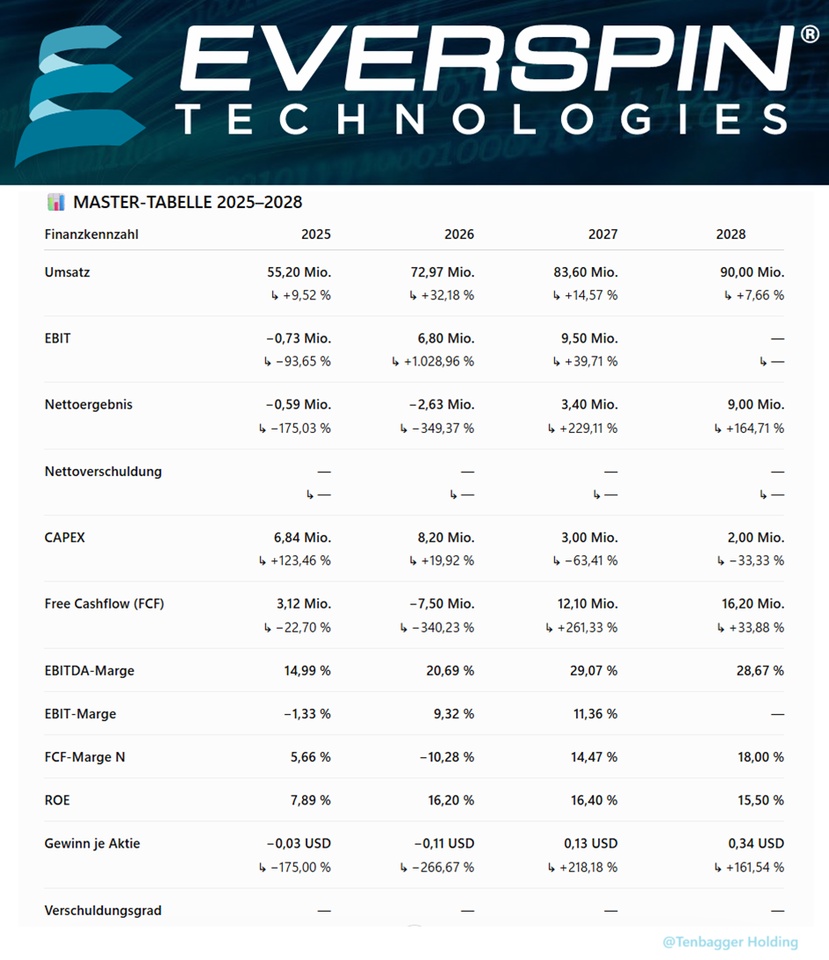
🔎 Particularly notable
- Revenue: 55.2 → 90.0 million USD by 2028.
- EBIT: turns from −0.73 million in 2025 to +9.50 million USD in 2027.
- Net income: Still negative in 2025/26, followed by a significant recovery to $9.0 million in 2028.
- FCF: at −7.5 million USD By 2026, it is expected to reach $16.2 million in 2028.
- EBITDA margin: rises from 14.99% to 28.67%.
- ROE: is estimated to reach 16.4%.
- Net debt and debt-to-equity ratio: MarketScreener shows no value
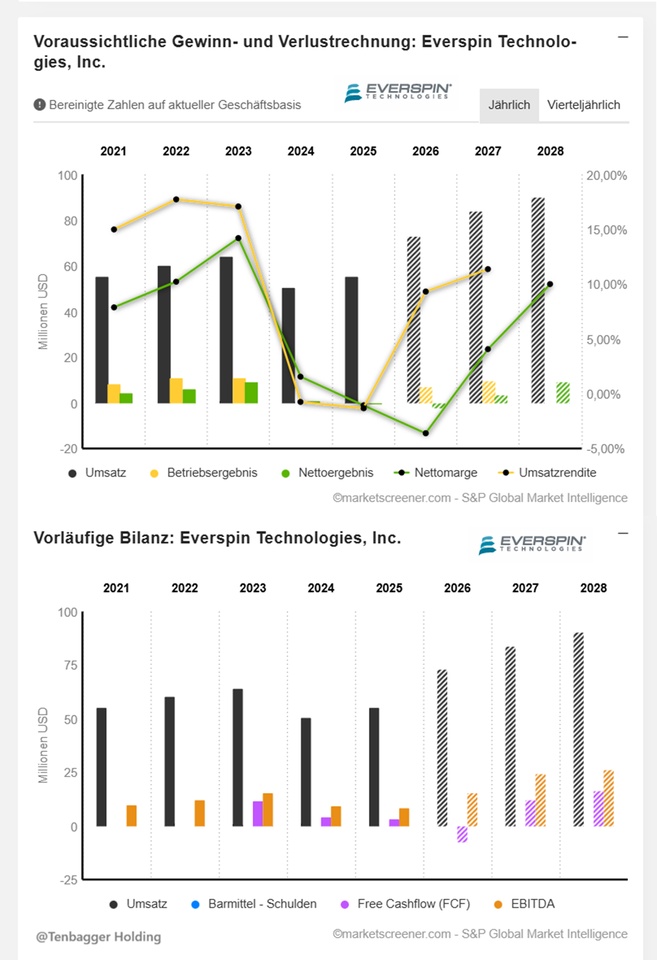
The 2026 P/E ratio is listed as -149.45, so don’t let the high P/E ratio throw you off too much here—instead, focus on the forward figures!
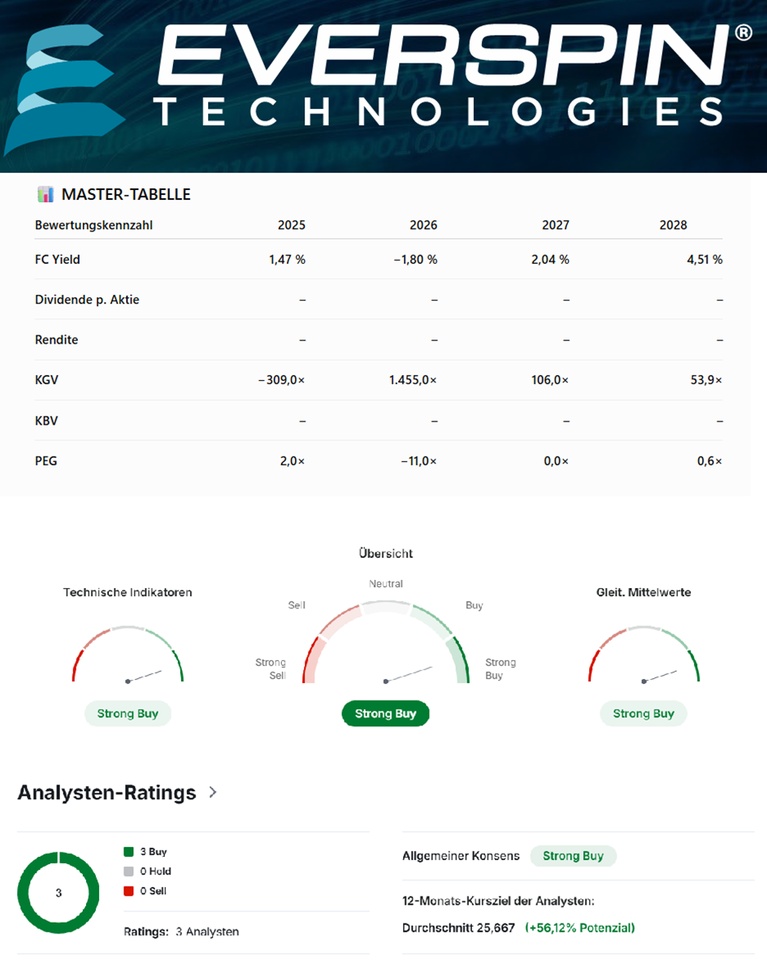
🔎 A concise interpretation
- FCF Yield: improves significantly from −1.80% in 2026 to 4.51% in 2028.
- P/E ratio: falls from an extremely high 1,455× in 2026 to 53.9× in 2028because earnings are improving significantly.
- PEG: decreases to 0.6× 2028 —based on this metric, the valuation thus becomes significantly more attractive.
- Dividend: According to MarketScreener, Everspin will pay 2025–2028.
- P/B ratio: MarketScreener shows no value .
@PikaPika0105 My friend, is there also a major player in Japan for MRAM?
August 12, 2026, 1:43:11 PM •
gettex (EUR)
14.49 EUR
+0.27 EUR +1.90%


