

Hello, everyone,
Analysts are now also keeping an eye on the second wave, and price targets are already being raised.
Just like with my company overview today.
Jefferies sees Dynatrace : More AI agents could require additional monitoring agents and thus more workloads to monitor. The higher price target of $75 signals that analysts believe the company can capitalize on this demand. The rating remains “Buy.”
Matthew Hedberg, an analyst at RBC Capital, raised his price target for Dynatrace stock from $59 to $73 and reaffirmed the “Outperform” rating. The adjustment reflects positive channel checks and the expectation of sustained operational momentum, following a strong first fiscal quarter with 41% organic, currency-adjusted growth in net annual recurring revenue.
Hedberg noted that the company is seeing sustained demand for its log management offerings, supported by a strong go-to-market strategy that is driving robust new customer acquisition. AI capabilities are also emerging as a significant growth driver for the business, as enterprise demand for unified observability and security continues to rise.
Dynatrace, Inc.. is an artificial intelligence (AI)-based observability platform. The company is advancing observability for digital enterprises and transforming the complexity of modern digital ecosystems into assets. It enables companies to analyze and automate. The platform combines comprehensive and in-depth observability, continuous runtime application security, and advanced AI to support IT operations, development, security, and business teams. This enables companies to optimize their cloud and IT operations, accelerate secure software delivery, and improve digital performance. The platform’s solutions include infrastructure observability, application observability, AI observability, digital experience, business analytics, software delivery, threat observability, application security, and log management. Application security detects, analyzes, and remediates vulnerabilities and attacks on applications in real time.
Number of employees: 5,600
FINAL_Dynatrace+Arize+Investor+Presentation+August+2026.pdf
Dynatrace + Arize: The Next Step in Growth Amid the AI Wave
My summary of the August 2026 investor presentation: Dynatrace no longer wants to merely monitor whether software functions technically. The company also wants to ensure that AI applications and autonomous AI agents operate reliably, efficiently, and cost-effectively. Arize was acquired for this purpose.
What makes this combination so interesting?
The two companies complement each other:
- Dynatrace: Monitors applications, cloud infrastructure, software performance, and security.
- Arize: Analyzes and evaluates AI models, large language models (LLMs), and AI agents. This includes, for example, detecting erroneous or fabricated AI responses.
- Common goal: To monitor the entire lifecycle of an AI application—from development through testing to production.
An example: A company uses an AI agent for customer service. While the agent functions flawlessly from a technical standpoint, it provides incorrect answers. Traditional infrastructure monitoring alone cannot reliably detect this problem. The combination of AI evaluation and observability is designed to make such errors visible and identify their causes more quickly.
2. Key figures from the presentation
Metric
Details
Purchase price of the Arize transaction:
$915 million
Of which, cash component:
approx. $815 million
Estimated market potential for AI observability through 2030:
over $10 billion
Expected additional contribution to ARR growth in 2027:
approx. 2 percentage points
Expected impact on the adjusted operating margin in 2027:
−1.75 percentage points
Planned completion:
now completed
The acquisition was completed on October 1, 2026.
(ARR stands for Annual Recurring Revenue.)
3. Why does this fit with the second wave of AI?
The first wave of AI was heavily focused on infrastructure: data centers, GPUs, storage, and networking technology.
In the second wave, a different question takes center stage:
How can companies actually use AI productively and make money from it?
To do so, they need, among other things:
- Reliability: Do AI applications and agents actually work under real-world conditions?
- Quality control: Do they produce accurate, helpful, and secure results?
- Cost control: What are the costs per request or per agent process executed?
- Error analysis: Is the problem with the model, the prompt, the application, or the infrastructure?
- Automation: Can errors be detected more quickly and, in some cases, resolved automatically?
This is precisely where Dynatrace positions itself with Arize.
The acquisition makes strategic sense. However, the key question will be whether Dynatrace can actually generate additional recurring revenue and higher long-term profits from the expanded platform.
4. My Conclusion for the 2036 Portfolio
I find Dynatrace’s strategic direction compelling.
The company isn’t simply relying on yet another AI assistant. It is positioning itself around a key prerequisite for the widespread adoption of AI: companies must be able to understand whether their AI systems are operating reliably, what costs they incur, and what business value they deliver.
I find three points particularly interesting:
Monetization: Dynatrace can sell additional features to existing enterprise customers.
Structural growth: As AI agents become more widespread, the need to monitor their behavior and results increases.
Platform advantage: The combination of AI evaluation, application monitoring, and infrastructure diagnostics could further embed Dynatrace into its customers’ workflows.
My assessment: Dynatrace is an interesting candidate for the second wave of AI. The Arize acquisition improves its strategic positioning. Whether this will also translate into an attractive investment, however, continues to depend on revenue growth, margin trends, and the expectations already priced into the stock.
The most important metric we should watch in the coming quarters is therefore ARR growth in conjunction with the operating margin. This will show whether the additional AI features are actually driving growth rather than just increasing costs.
Q1 FY 2027 Financial Results
Q1+FY27+Investor+Deck+-+FINAL+8.5.2026.pdf
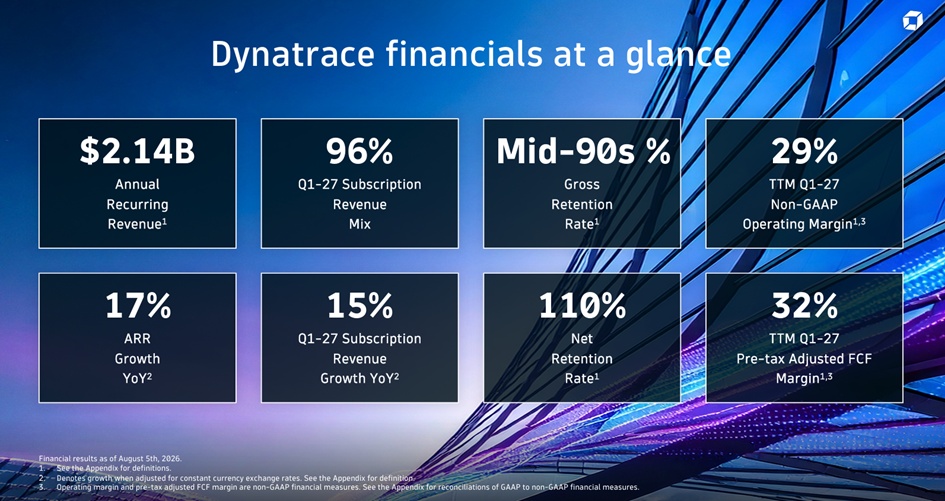
Dynatrace Q1 FY2027 – Key Takeaways
My brief summary: Dynatrace is benefiting from the increasing complexity of cloud and AI systems. What’s particularly interesting is that the company isn’t just keeping pace with the growth of AI infrastructure—by monitoring and optimizing AI applications, it’s also capitalizing on the second wave of AI—monetization— .
Key Figures
Revenue:
$555 million
+16%
Subscription revenue:
$530 million
+16%
Annual Recurring Revenue (ARR):
$2.136 billion
+17%
Operating Income (Non-GAAP):
$162 million
–
Operating Cash Flow
: $306 million
–
Adjusted Free Cash Flow:
$309 million
Dynatrace generates the majority of its revenue from recurring software subscriptions. This provides a revenue base that is relatively easy to forecast.
Important: In August, the company lowered its full-year forecast for fiscal year 2027. The current revenue forecast is $2.306 to $2.320 billion. Among other reasons, Dynatrace cites changed exchange rate assumptions. This is something to keep an eye on despite the strong first quarter.
Through the acquisition of Arize AI, Dynatrace aims to expand its capabilities for monitoring and evaluating AI models and AI agents. The company sees a market potential of more than $10 billion in the AI observability sector by 2030.
Are there dependencies on individual customers?
The good news: According to the annual report, there is no significant direct revenue dependence on any single end customer.
The annual report for fiscal year 2026 contains the following information:
Number of customers: Approximately 4,100 (broad customer base)
No single end customer accounts for more than 10% of revenue
International presence: Over 110 countries (geographic diversification)
Revenue model: Primarily subscriptions
The figures refer to the fiscal year ending March 31, 2026.
Dependence on major cloud platforms is a separate issue
Dynatrace integrates with major cloud and technology ecosystems, including AWS, Microsoft Azure, and Google Cloud. This is important for technical reach and customer access. However, this does not automatically mean that any one of these providers accounts for a large share of Dynatrace’s revenue. Such dependence must be distinguished from direct customer concentration.
My conclusion: The combination of recurring revenue, a broad customer base, and AI-powered observability is attractive.
Latest News
Oct. 12, 2026, 9:00 a.m. EDT
Oct. 1, 2026, 4:05 p.m. EDT
Aug. 18, 2026, 6:30 a.m. EDT
August 5, 2026, 6:30 a.m. EDT
Dynatrace berichtet Finanzergebnisse des ersten Haushaltsjahres 2027
July 29, 2026, 6:30 a.m. EDT
Dynatrace ernennt den KI- und Technologieführer Chandu Thota in seinen Vorstand
July 27, 2026, 9:00 a.m. EDT
Dynatrace bringt autonome Abläufe in Unternehmens-KI und entwickelt sich von Einsicht zu Handlung
April 8, 2026, 4:05 p.m. EDT
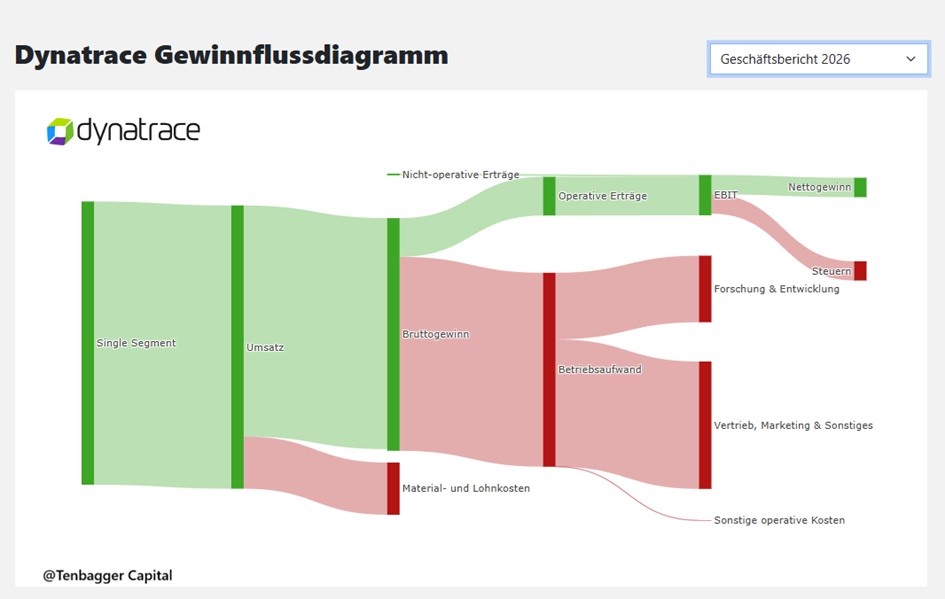
Geographic Revenue Breakdown:
2026 (USD)
United States 928 million
Europe, Middle East, and Africa 649 million
Asia Pacific 193 million
Latin America 159 million
North America (Excluding the United States) 89.76 million
5. My Brief Assessment of Dynatrace
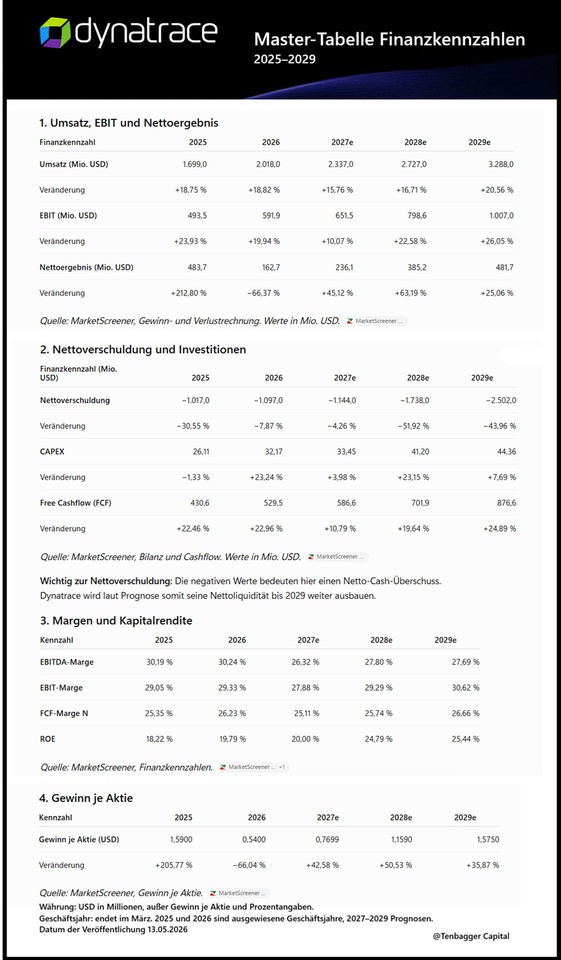
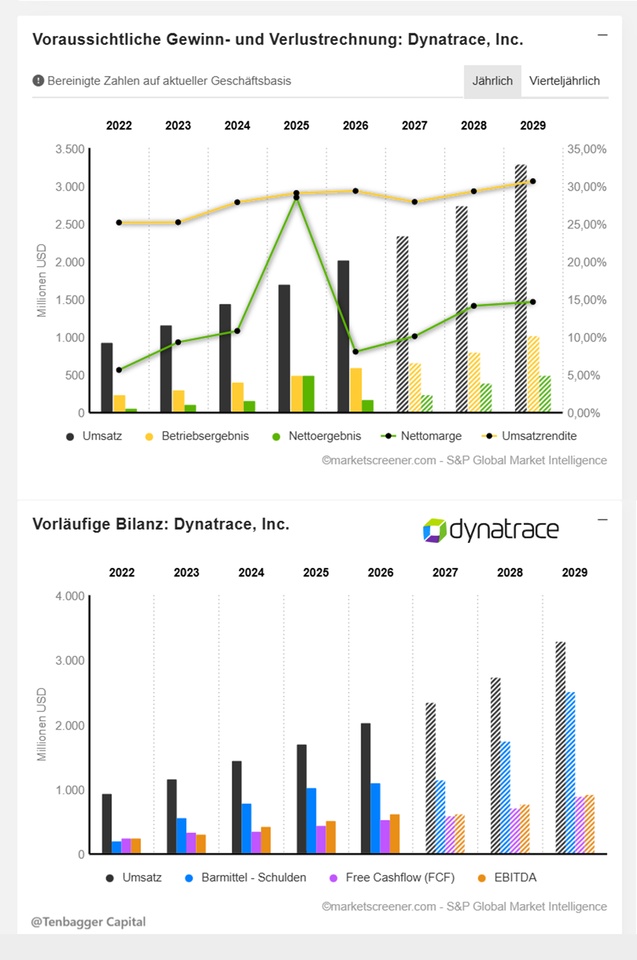
The forecast shows a growing software company with strong free cash flow. Three points stand out in particular:
- Growth: Revenue is expected to rise from $1.70 billion in fiscal year 2025 to $3.29 billion in 2029. That represents nearly a doubling.
- Cash Flow: Free cash flow is expected to grow from $430.6 million to $876.6 million. This would allow Dynatrace to generate significant funds for product development, AI capabilities, and further expansion.
- Profitability: The EBIT margin is projected to reach 30.62% in 2029. This points to a scalable business model.
The biggest point of concern is net income: The sharp decline from $483.7 million in 2025 to $162.7 million in 2026 is striking. Since EBIT is rising at the same time, one should examine the one-time effect—or the composition of net income—more closely before concluding that there has been an operational slump.
Purchase price of the Arize transaction
$915 million
The acquisition was completed on October 1, 2026.
Conclusion: Based on these forecasts, Dynatrace is particularly attractive due to its revenue growth, high cash flow margin, and rising EBIT margin. However, when making an investment decision, one must still compare these strengths with the current stock valuation.
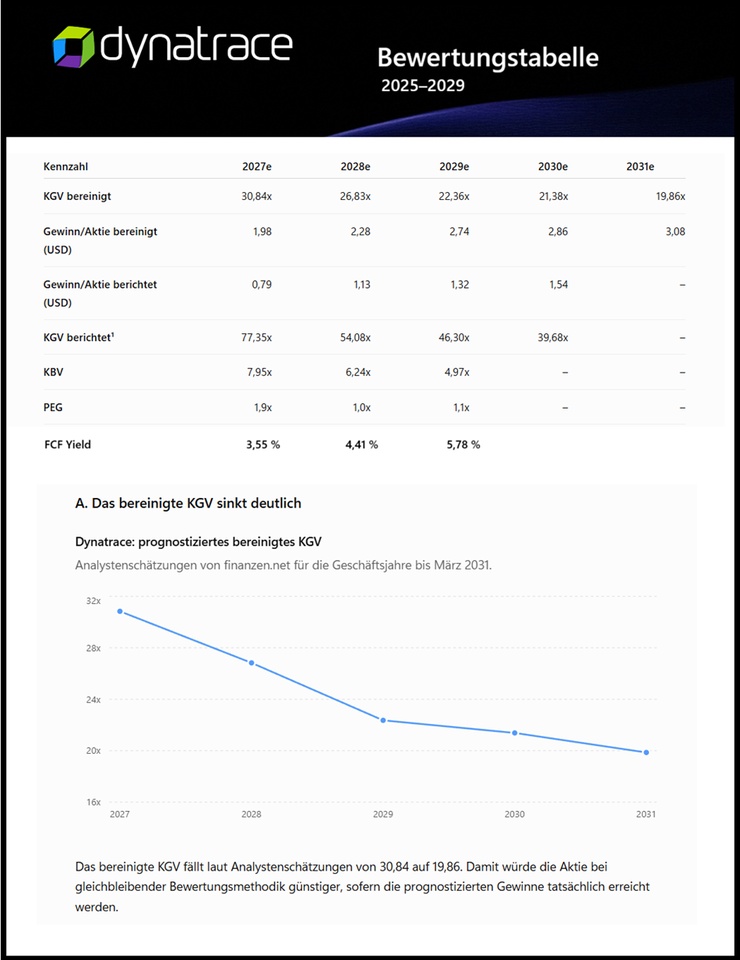
The reported P/E ratio is significantly higher
The difference between adjusted and reported earnings is substantial. For 2027, for example, adjusted earnings per share of $1.98 contrast with reported earnings per share of just $0.79.
That’s why I would always keep an eye on both metrics when it comes to Dynatrace. A low adjusted P/E ratio alone isn’t enough to classify the stock as undervalued.
The most stable metric for Dynatrace stock is adjusted earnings, which is used for the valuation below. The P/E ratio (price-to-earnings ratio) is 34.81 , which is 18.13 points below the historical average of 52.94 over the past 7 years. From this perspective, the Dynatrace stock appears to be to be (Source: AKTIENFINDER)
Dynatrace’s official forecast as a cross-check
On August 5, 2026, Dynatrace published its results for the first quarter of fiscal year 2027 and updated its full-year forecast.
Key figure for FY 2027
Official Forecast
Revenue
$2,306–2,320 million
Reported revenue growth
14–15%
Non-GAAP operating income
$682–690 million
Non-GAAP operating margin
29.5–29.75%
Adjusted earnings per share
$1.97–$1.99
Adjusted free cash flow
$610–615 million
Adjusted FCF margin
26.5%
The company’s forecast for adjusted earnings per share is thus virtually in line with the analyst estimate of $1.98. This serves as a useful plausibility check.
Note, however, that the non-GAAP metrics are adjusted figures and should not be equated with the reported IFRS/GAAP results.
My conclusion: Based on adjusted analyst estimates, Dynatrace is becoming more attractively valued as the forecast horizon extends. The combination of expected earnings growth and rising free cash flow is particularly appealing.
I would therefore consider Dynatrace an an interesting candidate for the second wave of AI . The key factor is whether the company can successfully monetize AI features and sustainably expand its margins and cash flows.
One final step is still needed for a buy decision: a valuation using a consistent, current stock price and a comparison of expected earnings growth with the risks. The table above therefore deliberately separates the adjusted valuation from the valuation based on reported earnings.
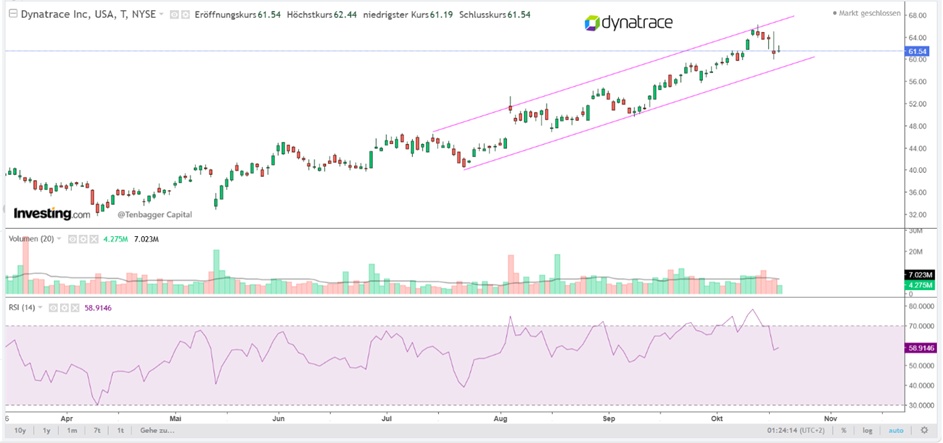
Dynatrace Stock
54.50 EUR
61.52 USD


