While the general public only talks about well-known AI software or graphics chip manufacturers when it comes to the stock market, they often overlook the most critical component of hardware physics: clocking. Every electronic device, every AI server, and every robot requires a clock (oscillator)—essentially a digital metronome—to ensure that data streams flow synchronously and without errors.
A technological disruption is currently taking place in this area, one dominated by a near-monopolist: $SITM (-2,12 %)
-
What does $SITM (-2,12 %) make special?
For decades, the industry has used traditional quartz crystals for timing. However, these are bulky, mechanically fragile, and sensitive to vibrations and heat. SiTime replaces quartz with MEMS (microelectromechanical systems) —tiny mechanical oscillators etched onto silicon. SiTime commands a global market share of over 80%. Its silicon oscillators are up to 50 times more reliable, microscopically small, and completely immune to extreme environmental conditions.
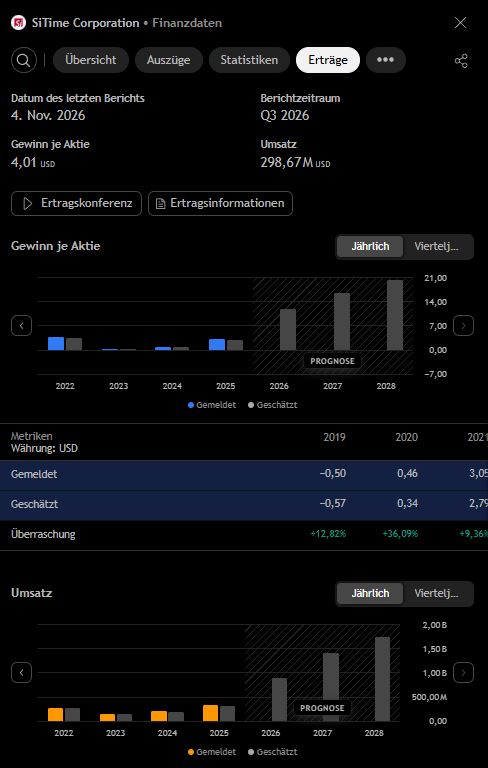
A Look at the Latest Q3 Report
The recently released quarterly figures (including the first full quarter following the strategically important TPD acquisition) demonstrate the enormous scaling power of the fabless (fabless) business model:
- Revenue surge: Revenue skyrocketed year-over-year by +257% to $298.67 million (annualized run rate of over $1 billion).
- Software Margins on Hardware: SiTime delivers a non-GAAP gross margin of 70.7% and an operating margin of 43%. Non-GAAP net income more than quintupled to $130.3 million (EPS of $4.01).
- Financial Strength: The company holds $324 million in pure cash and short-term investments—with minimal debt. A 3-for-1 stock split was announced for early December.
The Two Major AI Growth Waves
SiTime is positioned to benefit from two successive structural tech waves:
Wave 1 (Now – AI Infrastructure): High-end data centers are radically transitioning to ultra-fast optical networks (1.6 Tb connections). With these optical transitions, the value of SiTime components per module doubles or triples. Consequently, the Cloud/Data Center (CED) segment grew by +202%.
Wave 2 (Future – Edge AI & Wearables): As soon as AI models are embedded directly into billions of end devices (smart AI glasses, edge robotics, autonomous vehicles), MEMS technology will be indispensable. Quartz is too large and power-hungry for compact wearables. The Mobile IoT segment has already surged by +133% , driven by the design efforts of an unnamed consumer giant (rumored to be Apple).
R&D and the $10 Billion Pipeline
With a quarterly R&D reinvestment of $48.6 million , SiTime is building an insurmountable wall of patents. They are conducting research into atomic-clock-level precision at the chip level and absolute vibration immunity for co-packaged optics (CPO). The result: The entire design pipeline for future customer orders has quadrupled since 2025 to 10 billion USD (of which over $4 billion is in the semiconductor sector and $1.4 billion in the industrial/robotics sector). This pipeline is scheduled to enter 2028/2029.
Investment Thesis & Risks
SiTime is the non-cancellable toll booth for the physical synchronization of the digital future. It combines the IP pricing power of a software company with the physical irreplaceability of critical hardware.
⚠️ The risks: SiTime has no manufacturing facilities of its own and is therefore dependent on global wafer supplies from major foundries. Supply bottlenecks (such as those currently occurring with TPD products due to spikes in demand) can temporarily slow growth. In addition, the strong concentration on a few large customers in the consumer and cloud sectors leads to cyclical shifts in quarterly orders, making short-term forecasting difficult.