Hello, everyone,
Especially during the current correction, there’s often a lot of fear surrounding stocks that have corrected sharply.
This is particularly true for cyclical stocks.
High interest rates typically hurt cyclical stocks, but is this fear justified in the case of Micron $MU (-6,84 %) justified? And how many cyclical stocks do we even have left here?
This question is certainly valid and important for my largest position.
My previous view of cyclical stocks may have been too heavily influenced by the traditional memory industry. The AI boom and entirely new growth areas could structurally transform the business model.
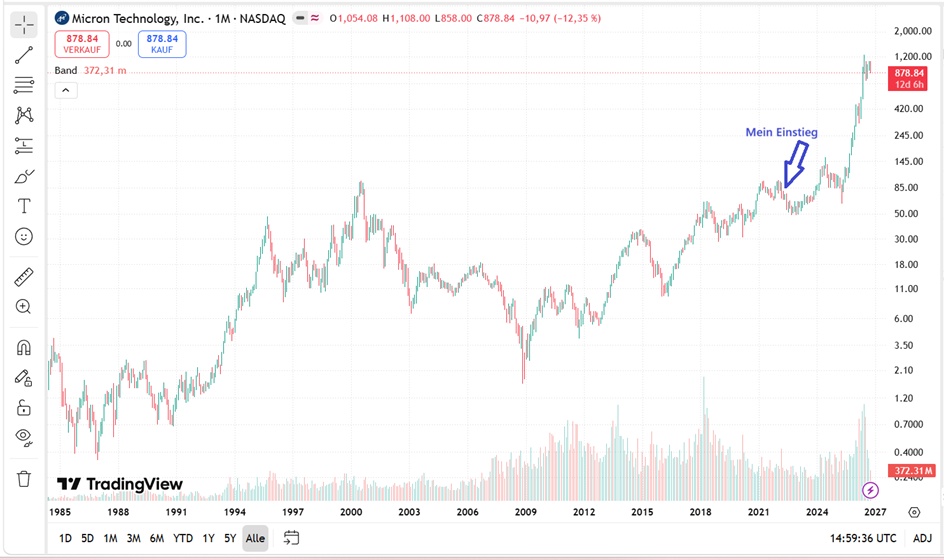
The long-term chart also reveals something interesting: While Micron has experienced pronounced boom and bust cycles in past decades, the recent rise in its stock price could signal a new trend. The key question is whether its earnings power is also changing permanently.
1. An important point: Micron is increasingly selling future capacity
In June 2026, Reuters reported that Micron had already had concluded 16 long-term contracts with strategic customers totaling $22 billion in commitments . The contracts include multi-year purchase commitments and, in some cases, price floors.
In September, according to published company data, the number of these agreements rose to 26. They are expected to cover more than 35% of revenue by 2030.
This is crucial for my analysis.
Until now, the traditional memory business has been heavily influenced by short-term fluctuations in supply and demand. When demand rose, manufacturers invested in new capacity. As soon as this capacity became available, an oversupply could develop and put pressure on prices.
Micron is now attempting to reduce some of this risk.
Strategic customer contracts can improve the predictability of demand and the stability of revenues.
However, they do not completely eliminate cyclicality: Not all revenue is contractually secured in the long term, and agreed-upon prices, product mix, and production costs remain important.
2. Is Micron’s capacity fully booked through 2030?
I would make a slightly more nuanced distinction here.
Micron management stated in September 2026 that more than 75% of the production expected for 2027 was already covered by customer commitments and orders. In addition, the company reported that discussions with customers already extended well into 2028. Some strategic customer contracts ran through 2031.
https://www.fortune.com/company/micron-technology/earnings/q4-2026/?utm_source=chatgpt.com
That’s a strong signal.
However, it doesn’t mean that the entire production run through 2030 is completely sold out. We need to distinguish between three things:
- HBM: Particularly high demand driven by AI accelerators; a large portion of production for 2027 had already been allocated.
- Total memory production: A significant portion is covered by orders and agreements, but not all of it.
- Production through 2030: There are long-term agreements and high demand, but this does not mean that all production volumes and prices are fully secured through that date.
At the same time, Micron is planning significant capacity expansions. New plants take years to reach meaningful production volumes. This could contribute to supply not growing as quickly as demand.
My conclusion: The reports support my thesis of a prolonged supply shortage. However, the statement that all production is sold out through 2030 is too sweeping for my taste.
3. The Decisive Shift: No Longer Just Memory Prices, but Strategic Importance
For me, this is the core of my investment thesis.
AI requires more than just powerful processors. It also requires large amounts of fast memory. Without sufficient memory bandwidth, even a powerful AI chip cannot fully realize its potential.
This changes the importance of memory within the value chain.
Micron may benefit from three structural changes:
1. Rising memory demand: Larger models and more AI applications running simultaneously are increasing memory demand.
2. HBM as a key component: High-performance memory is becoming increasingly important for modern AI systems.
3. Long-term customer loyalty: Customers are securing supply volumes early on because a shortage of memory can limit the expansion of their own systems.
Micron itself describes this trend in its corporate documents as a structural shift in the market. While this is initially the company’s perspective, it is supported by long-term customer agreements.
4. What does the long-term chart show?
The chart shows Micron’s performance since 1985. Three distinct phases stand out:
- Earlier decades: Strong upward movements were repeatedly followed by significant declines.
- 2010 to 2023: The company continued to grow but remained visibly subject to major fluctuations.
- Since 2024: An exceptionally steep rise in the stock price, indicating sharply increased expectations regarding long-term profitability.
The chart alone does not reveal whether the stock is overvalued or whether the new trend will be sustainable.
However, it does show that the market now attributes significantly greater economic importance to Micron.
An important point for me as a long-term investor: The stock can still experience significant temporary declines even amid structurally improved business performance. The key question is whether the fundamental outlook is also deteriorating.
My friends, I experienced this firsthand when I bought in back in 2023. I bought in based on a favorable valuation and positive forecasts. But investors weren’t interested in the stock, and I slipped into double-digit losses.
I then took advantage of this opportunity to buy a little more.
5. My Reassessment of the 2036 Portfolio
I would no longer simply classify Micron as a traditional cyclical memory manufacturer.
My updated classification:
Criterion
My Assessment
Long-term AI growth driver
Very strong
Importance of HBM
Strategically high
Long-term customer loyalty
Improving due to multi-year agreements
Predictability of demand
Better than in the traditional memory model
Cyclicality
Still present, possibly less pronounced
Competitive risk
Remains
Valuation following an exceptional price increase
Examine particularly carefully
Portfolio role
Strategic growth position with cyclical risks
What does this mean for my position?
Micron is the largest position in my portfolio, accounting for approximately 9.8%.
I will not question this position simply because memory manufacturers have historically been cyclical. Rather, I will examine whether the new contract structures, HBM demand, and long-term supply shortages enable higher and more stable profitability.
At the same time, I will not automatically interpret the price increase as proof that the stock must continue to rise sharply in the long term.
My conclusion: The thesis is plausible: Micron could evolve from a highly cyclical memory manufacturer into a strategically more important supplier for AI infrastructure. The long-term customer agreements are an important indicator of this. However, whether cyclicality will actually decrease significantly and permanently remains to be seen over the course of several years.
The most exciting next question for the 2036 portfolio is therefore: How high could Micron’s sustainable profit be in 2030 if demand for AI memory remains high and the long-term contracts cushion some of the previous cyclicality?
6. New technologies such as robotics, autonomous systems, and AI-driven automation are massively increasing demand for high-performance memory and storage solutions
– and this is precisely where Micron benefits directly. Robots, autonomous vehicles, industrial IoT systems, and AI data centers generate enormous amounts of data that require fast DRAM, NAND, high-bandwidth memory (HBM), and edge-optimized storage.
I’ll now walk through, in a structured and precise manner, how these technologies impact Micron—based on the current Micron page
https://www.micron.com/?utm_source=copilot.com
Robotics & Autonomous Systems → Explosion of Edge Data
Micron supplies the critical components for this:
- LPDDR DRAM for fast real-time processing
- Industrial NAND for robust data storage
- Zero-Defect Memory for safety-critical robotics (industrial, aerospace)
https://www.micron.com/?utm_source=copilot.com
🚗 Autonomous Vehicles → Memory as a Safety Factor
Micron has been active in the automotive memory sector for 30 years. Autonomous vehicles require:
- Gigabytes of DRAM for sensor fusion
- TB of NAND for driving data, maps, and logs
- Extremely rugged memory chips (temperature, vibration, lifespan)
New technologies such as:
- Level 4/5 autonomy
- Advanced Driver Assistance Systems (ADAS)
- AI-powered navigation
→ are driving storage demand exponentially.
Micron is one of the top 3 global suppliers of automotive memory—a direct driver of growth.
https://www.micron.com/?utm_source=copilot.com
🏭 Industrial IoT & autonomous factories → Memory as infrastructure
Micron itself emphasizes: “Memory and storage for industrial IoT solutions” .
Autonomous factories require:
- Edge AI systems
- Robot fleets
- Predictive maintenance sensors
- Real-time data processing
This leads to:
- More DRAM per device
- More durable NAND memory
- Higher reliability requirements (zero-defect)
Micron positions itself here as a premium supplier for industrial robotics and aerospace.
https://www.micron.com/?utm_source=copilot.com
🤖 AI Robots & AI Inference → Memory as a “Superpower”
Micron itself writes: “The rise of smarter robots and why memory is becoming their superpower” .
Why?
- AI models are increasingly running on-device
- Robots must make decisions locally, not in the cloud
- This requires fast, energy-efficient DRAM
Micron delivers:
- LPDDR5X for mobile/robotic AI
- HBM3E for AI data centers
- GDDR7 for high-performance robotics
This makes robots more intelligent, more responsive and more autonomous.
📈 Overall impact on Micron
New technologies → more data → greater storage demand → Micron benefits directly.
Positive for Micron:
- Rising demand for DRAM & NAND
- Higher margins in the automotive and industrial sectors
- Strategic role in AI data centers
- Long-term contracts with robotics and automotive manufacturers
- U.S. expansion (USD 250 billion by 2035) strengthens market position
Risks:
- Cyclical memory prices
- Competition from Samsung and SK Hynix
- High CAPEX for new fabs
7. Where is the moat?
Micron’s competitive advantages lie primarily in:
- Technological expertise: The manufacturing of modern memory chips is complex.
- Capital intensity: New manufacturing capacity requires significant investment.
- Manufacturing experience: Quality, yield, and reliability are crucial.
- Customer qualification: New storage solutions must meet demanding technical requirements.
So the moat is real. However, it is not as impregnable as that of a software company with high switching costs.
The Risks
On October 15, Reuters reported on signs of technical weakness in Micron’s stock. Other market reports pointed to progress made by Chinese memory manufacturers. This does not automatically mean that Micron’s long-term market position is at risk. However, it does show that investors must keep a close eye on both the company’s valuation and developments among its competitors.
Three risks are particularly important:
Cyclical memory prices: Supply and demand can change rapidly.
New competition: Additional production capacity can put pressure on prices.
Excessive expectations: Even strong financial results can be disappointing if the market expects even more.
8. What do the numbers say?
On September 30, 2026, Micron reported record figures for the fourth quarter and the full fiscal year 2026:
Key Figure
Fiscal Year 2026
Q4 Revenue
$54.23 billion
Q4 Net Income
$37.70 billion
Q4 Operating Cash Flow
$43.97 billion
Revenue Growth Compared to Q3
Significant increase
Outlook
Record fiscal year 2027 expected
The published figures are exceptionally strong. At the same time, one should view the high profits in the context of the current memory cycle: they cannot simply be extrapolated unchanged into the future.
7. Micron – Valued Favorably Based on Key Metrics, but Not Necessarily a Bargain
On October 16, Micron was trading at around $879. A recent overview of key metrics showed a price-to-earnings (P/E) ratio of about 11.8 and an expected P/E ratio of about 5.
https://stockanalysis.com/stocks/mu/statistics/?utm_source=chatgpt.com
At first glance, this looks extremely cheap. But for memory manufacturers, the P/E ratio alone is problematic.
Why?
When memory prices rise, revenue and earnings often grow particularly strongly. The P/E ratio then falls because earnings rise faster than the stock price.
When the cycle turns, earnings can subsequently decline significantly. A seemingly low P/E ratio can then prove to be misleading.
My assessment:
- Business outlook: Positive, especially for HBM and AI memory.
- New growth sectors: Well-positioned and less exposed to cyclicality
- Valuation: Low based on current earnings, but cyclical.
- Portfolio risk: At 9.8%, this is a very large individual position.
- What I should examine: How high would earnings be if storage prices returned to normal?
Added to this is competition from China: New storage technologies could increase price pressure in the long term. However, it remains to be seen how quickly this will actually pose an economic risk.
My assessment: Micron remains an interesting investment. However, given its high weighting in the portfolio, I will examine particularly carefully how much of its current profitability is likely to be sustainable.